
18 Jun 2026
Picture this: a busy ICU full of the sickest patients in the hospital. Every ICU bed is full, it’s 4:00 p.m., and some nurses haven’t had a break since their shift started at 7:00 a.m. The high acuity of the patients requires extensive monitoring from multiple devices. Dings, beeps, vibrations and alarm lights are coming from all devices, even the mobile devices in the RNs’ pockets. A numbness to these stimuli sets in among the care team as they simply try to keep their patients safe and alive.
This scenario is recognizable by nearly every nurse I talk to. I have the privilege and duty to speak with nurses across the country in various care settings, from community hospitals to large medical centers. The stress and fear about the impact of alarm fatigue on these nurses is palpable.
The constant alarm noise is more than annoying; it is bad for patients. Creating a calm, quiet, healing environment for patients is a consistent goal of the care team. Organizational, multidisciplinary change management around the healing environment is required to support caregivers with solutions that reduce noise, alarm fatigue and nonactionable alarms. The complex operations and solutions that support a healing environment must be consistently evaluated and improved to keep pace with the ever-evolving micro- and macro-level care delivery systems.
The healthcare industry has tried to solve the problem of alarm fatigue for decades. One significant event is the Summit on Clinical Alarms, held in 2011. Convened by the Advancing Safety in Medical Technology (AAMI), the U.S. Food and Drug Administration (FDA), the Joint Commission, the American College of Clinical Engineering (ACCE) and the ECRI Institute, the summit was an elite gathering of interprofessional stakeholders. The resulting report declared, “Medical alarm systems are out of control.”1
Attention to the problem continued to grow, and in 2014, the Joint Commission established January 1, 2016 as the deadline for hospitals to create an alarms management strategy to maintain accreditation.2
Not so fast. A full decade after an alarm management strategy became an accreditation requirement, nonactionable alarms and the resulting alarm fatigue continue to be a problem.
While the reasons that organizations struggle to address alarm management issues vary by facility, I see three persistent problems that prevent successful alarm management. The good news is, with tenacity and focus, each of these issues can be conquered.
Many groups – nursing, respiratory therapy, IT and others — are affected by alarm mismanagement, which results in no single group being responsible for its resolution.
Establishing a standing multidisciplinary alarms committee is essential to developing effective alarm management policies. Such a committee is, by definition, a group with ownership of the problem.
It is important to ensure that all stakeholders are represented on your committee. I’ve seen hospitals with a clinician-focused alarm committee overlook important IT issues, just as an IT- or clinical engineering-focused team may not understand the issues that nurses encounter at the bedside.
Every hospital’s first priority should be patient care. That care consumes most of the time and energy of hospital staff. Beyond patient care, there are a host of other demands, varying in urgency and importance, that lay claim to staff’s time. Alarm management tends to fall into what business author Stephen Covey calls the second quadrant: tasks that are important but not urgent. Second quadrant tasks are central to achieving long-term goals, but are often postponed because of other, more urgent tasks, even when those tasks are less important.
Even when committees exist, regular meetings may not be a priority. For example, I know of alarm committees that only meet when there is a patient safety or regulatory issue, and then disband until the next problem, never addressing core alarm management strategy.
When the C-level makes alarm management a priority, other staff does as well. Obtaining C-level buy-in elevates the alarm committee’s work and adds a sense of urgency that moves alarm management out of the second quadrant.
Without access to alarm data, even a multidisciplinary alarm committee with C-level buy-in deteriorates to creating recommendations based on best guesses or spending inordinate amounts of time gathering information.
Access to alarm data and assistance in data navigation and interpretation ensure that committee recommendations are based on the organization’s needs and eases the time burden of information gathering.
While data access is the first step, members of the alarm committee need tools to gain meaningful insights from that data. A huge spreadsheet may contain the exact information the committee needs, but if they cannot do meaningful queries, that data remains locked from interpretation.
In contrast, hospitals that know how to navigate and interpret alarm data can make quantum leaps in personalized patient care. For example, long-term care facility Elizabeth Seton Children’s Center takes a very personalized approach to customizing alarm parameters, setting precise alarm limits for each resident. Key to this approach is mining surveillance data for clinical insights. At monthly meetings, staff review charts that indicate which units have the most alarms, as well as individual residents’ alarm data, to determine if adjustments are required. The team’s goal is to reduce alarms to 10 per resident per day.
One thing I’ve learned from working with our customers is that all hospitals are data hungry. Organizations with tools that provide efficient access to data and insights into the data’s meaning have a significant advantage. Comprehensive alarm data analysis is key to the successful application of clinical strategies and technologies that support managing device alarms.
What strategies have reduced alarms where you work? I’d love to hear from you. You can reach me at kyle.karajankovich@philips.com.
Kyle Karajankovich is a Clinical Strategy Lead for the Hospital Patient Monitoring service organization of Philips.
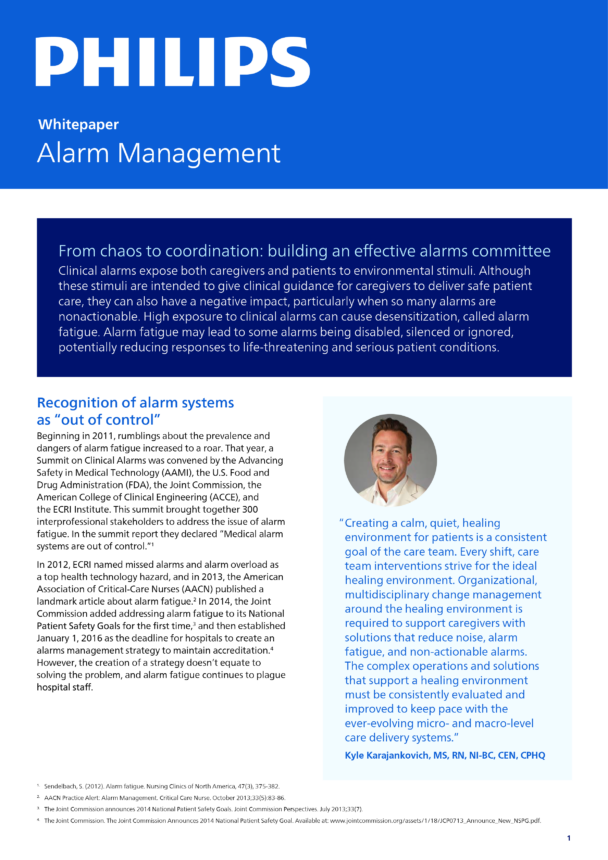
For a deep dive into alarm management and how to build an effective alarm committee, read this white paper.
Download