
05 Mar 2026
Hospitals face growing pressure to do more with fewer resources. Patient volumes continue to rise while staffing shortages, budget constraints, and operational complexity increase. Clinicians are expected to deliver high-quality care with limited time and support.
Under these strained conditions, what can hospitals do to increase efficiency? Hiring alone won’t close the gap between demand and capacity.
Those who are interested in improving clinical productivity should look to systems that reduce manual processes and workflow friction with comprehensive clinical data, context-aware surveillance, and workflow automation. These systems can support clinical productivity by potentially reducing alarm fatigue, accelerating time-to-insight, and allowing clinicians to spend more time on patient care rather than administrative processes.
Clinicians work hard to maintain and optimize productivity, but effort alone can’t overcome systemic bottlenecks in the tools and workflows that support care. The following challenges consistently limit how effectively hospitals can use clinician time and resources.
Disconnected device ecosystems force clinicians to rely on manual workarounds, such as transcribing vitals from bedside monitors into the EHR or reconciling conflicting readings across systems. These gaps can consume clinician time, increase the risk of errors, and slow clinical decision-making.
Alarm fatigue and data overload dilute clinician focus, making it harder to identify true deterioration events and potentially delaying intervention.
Manual documentation tasks pull clinicians away from patient care, increase burnout, and may increase the risk of documentation errors.
Disconnected workflows make it harder for care teams to recognize patient risk and coordinate a timely response.
Labor shortages magnify the effects of these challenges. Limited staffing will likely continue to add pressure to care teams moving forward, with the World Health Organization estimating a health worker shortage of about 11 million by 2030.1
Patient safety may be at risk when care teams don’t have timely, reliable and comprehensive data, making it harder to recognize early signs of deterioration and escalate care appropriately.
Clinician burnout can increase when systems force them into repetitive, low-value tasks and reactive workflows. This strain can affect turnover rates and make it harder to maintain consistent care standards.
Financial strain could deepen as hospitals absorb the cost of overtime, recruitment, and other adverse events. Nurse turnover alone carries a significant price tag—the average cost of replacing a bedside RN exceeds $61,000, with hospitals losing an estimated $3.9 million to $5.7 million annually due to turnover.2
Clinicians focused on improving clinical productivity should start by addressing the system-level sources of inefficiency rather than layering on incremental fixes.
Clinical productivity breaks down when bedside data lives in silos. Across units and vendors, clinicians are forced to manually reconcile readings, track down missing information, and rely on workarounds that can slow care and introduce risk.
Hospitals can address this by unifying medical device data. With a vendor-neutral medical device information platform (MDIP), data from monitors, ventilators, infusion pumps, and other connected devices is integrated into a central, real-time stream that follows the patient across care settings. Clinicians can access the integrated data within their existing workflows.
This can potentially reduce documentation errors, save time, and optimize clinical workflows by eliminating manual data handling and creating a shared source of truth.
Manual documentation remains one of the most persistent drains on clinical productivity. Clinicians sometimes spend hours entering, re-entering, and validating patient data—time that could otherwise be spent on direct patient care. These repetitive tasks also increase the likelihood of transcription errors and can contribute to burnout.
Organizations can address this friction by automating medical device data documentation at the point of care. Patient data is captured directly from devices, validated automatically, and sent into the EHR without requiring clinician intervention.
By eliminating manual data entry, a hospital’s goal is to free up clinician time, reduce transcription and documentation errors, improve data accuracy, and lower the risk of preventable adverse events.
When clinicians are bombarded with non-actionable alarms, it becomes harder to identify which signals urgently require intervention. This can lead to missed deterioration events, delayed responses, and reactive care.
Implementing smart rules and contextual alerts helps prioritize meaningful changes in patient condition by aligning notifications with clinical protocols, trends, and thresholds. When clinicians receive fewer alerts—and the ones they do receive are informative—care can potentially be delivered more efficiently, perhaps even proactively.
This approach can support potentially faster response times, fewer adverse events, and better staff allocation by allowing care teams to focus attention where it is most urgently needed.
Many deterioration events occur outside of critical care settings, yet med-surg and other lower-acuity units often rely on intermittent vital sign checks. This creates gaps in visibility, delays escalation, and places additional burden on already stretched staff.
By moving away from episodic checks and implementing continuous monitoring across non-critical care settings, teams gain real-time visibility into patient status. Integrated surveillance platforms centralize live device data, trends, and events, apply early warning scoring systems, and enable timely escalation when risk increases.
Continuous patient monitoring can support teams in detecting patient deterioration early, respond more quickly, and reduce documentation and device management burdens.
Rigid systems that can’t adapt to new devices, care settings, or evolving requirements become harder to maintain and integrate over time.
Hospitals can future-proof clinical workflows by adopting platforms designed to scale across devices, vendors, and care environments. These platforms are built to support expansion into med-surg, telemetry, virtual care, and centralized monitoring without requiring wholesale infrastructure replacement.
By prioritizing scalability, organizations can potentially reduce long-term IT burden, strengthen system resilience, and support more efficient adoption of new technologies.
A key factor in implementing strategies for improving productivity—and sustaining those improvements over time—is addressing the underlying sources of inefficiency through technologies that help streamline data, reduce manual tasks, and support more informed decision-making.
A productivity-enabling system should deliver:
Clinical productivity should be treated as a sustained organizational capability—not a temporary response to staffing shortages or operational pressure. That requires technologies designed to support clinical work consistently over time, including clinical workflow automation for repeatable tasks and infrastructure that reduces reliance on manual effort.
Hospitals that take this approach can focus less on short-term fixes and more on creating a foundation that can adapt as demand, care settings, and technology continue to evolve.
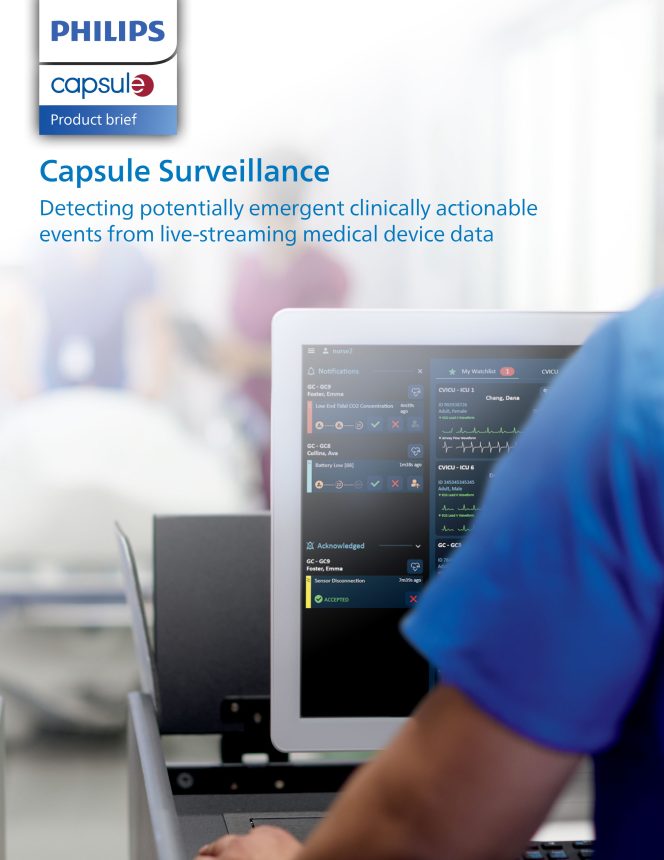
The solutions of the Philips acute care informatics portfolio support clinical productivity by unifying medical device data across vendors, automating device-driven data flow into clinical systems, and enabling clinical surveillance using real-time measurements, alarms, and waveforms across bedside, telemetry, and virtual care environments.
Request a demo to see how Philips technologies can help hospitals build scalable, integration-ready infrastructure that supports efficient clinical workflows.
Learn more about device integration and clinical surveillance.
Download