Philips Capsule MDI
Medical Device Integration (MDI) solution comprises hardware, and software. It can help mitigate the obstacles of device-specific protocols, security challenges across the organization, and slow adoption of industry-wide, standards-based interoperability.
Vendor-neutral to medical device manufacturers
Philips Capsule MDI is a vendor-neutral platform that integrates data from 18+ device types across 150+ manufacturers, combining device drivers, connectivity hubs, and data management software to deliver near real-time clinical data to 100+ systems, with the aim of improving documentation, reducing errors, and making timely decisions.

0
Philips Capsule MDI helps integrate data for 40M+ patients per year

0
Philips Capsule MDI is compatible with 1200+ medical devices

0
4300+ healthcare facilities across the world use Philips Capsule MDI
Built around your clinical workflows,
designed to scale
Philips Capsule provides a building-block approach to medical device integration. Through onsite assessments and design sessions, we map your workflows, devices, and clinical data needs to deliver a solution that fits today and scales for tomorrow. The result is a centralized platform that securely connects and shares context-rich data across all your clinical systems.
Connectivity Options
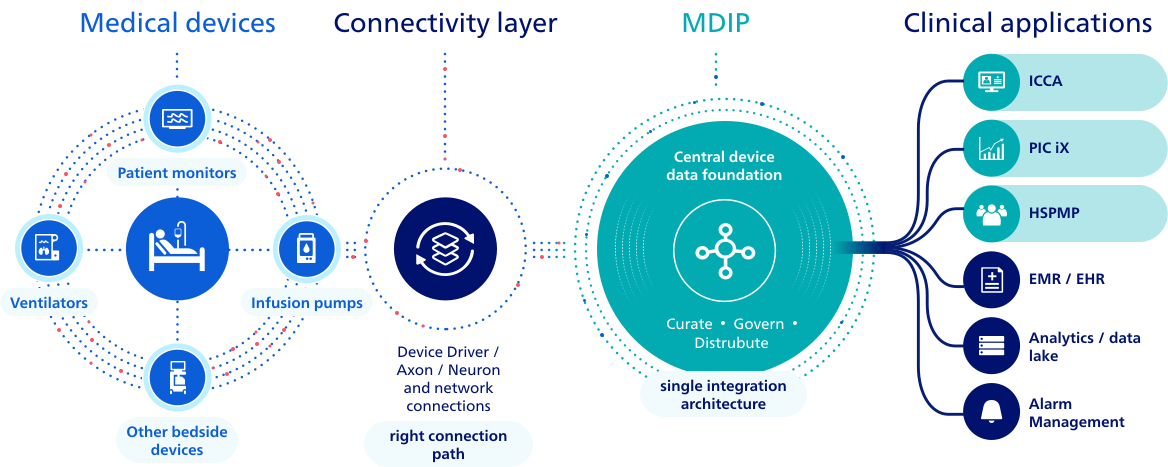
Philips Capsule connectivity hubs provide a physical connection point at the point of care. They take data from the connected medical devices and share it with the downstream systems through the data management software MDIP. Axon and Neuron are the two connectivity hub families.
Explore our solution:
Learn more
Device Drivers
Device Driver Interfaces (DDIs) are modular software drivers that extract and standardize data from medical devices for integration. They connect devices to the MDI solution, enabling vendor-neutral compatibility with over 1200 devices and allowing rapid customization to scale with evolving clinical workflows and care environment needs.
Explore our solution:
Learn more
Medical Device Information Platform (MDIP)
Medical Device Information Platform (MDIP) is data management software that receives device data from DDI and connectivity hubs, associates it with patients, and translates and curates it based on customer-defined mappings, enabling near real-time transfer of contextualized data to downstream clinical systems.
Explore our solution:
Learn more
Seamless growth with secure, standards-based integration
Built to grow with your organization, Philips Capsule MDI delivers standards-based integration and end-to-end security that help mitigate technical barriers like device-specific protocols and complex security requirements. Whether expanding into new departments or adopting new devices, MDI platform can scale across your clinical environment and systems.
Medical Device Integration (MDI) portfolio
What leading healthcare organizations say about partnering with us
Cambridge
University Hospitals
Cambridge University Hospitals NHS Foundation Trust (CUH) has long been focused on creating a digital healthcare environment to improve the lives of patients.
Are you ready to advance
your care delivery?